Pages

.

John Taylor uncovers a hideous threat to our freedoms


John Taylor uncovers a dire and hitherto little-known threat to the freedoms we Americans hold dear:

In a recent speech at Stanford former Wells Fargo Chairman and CEO Dick Kovacevich told the full story of how he was forced to take TARP funds even though Wells Fargo did not need or want the funds. The forcing event took place in October 2008 at a now well-known meeting at the U.S. Treasury with Hank Paulson, Ben Bernanke, as well as several other heads of major financial institutions... 
“You might ask why didn’t I just say no, and not accept TARP funds.” [Kovacevich] then explained: “Hank Paulson turned to Chairman Bernanke, who was sitting next to him and said ‘Your primary regulator is sitting right here. If you refuse to accept these TARP funds, he will declare you capital deficient Monday morning.’ This was being said when we were a triple A rated bank. ‘Is this America?’ I said to myself.”... 
According to Kovacevich: “It was truly a godfather moment. They made us an offer we couldn’t refuse.” It was also truly a deviation from the principles of economic freedom, such as those I have highlighted in my book First Principles—predicable policy, rule of law, reliance on markets, limited scope for government... 
[A]fter his talk, I asked Dick Kovacevich why more business people were not speaking out on this important issue. He explained how he had in fact waited a long time after he left Wells Fargo before speaking out because he did not want to risk some kind of retribution. He said he thought many others had a “fear” of speaking out.” 
In their book Free to Choose Milton and Rose Friedman wrote about this problem: “Restrictions on economic freedom inevitably affect freedom in general, even such areas as freedom of speech and press.” (p. 67) They quoted from a letter they received from business executive Lee Grace. I was reminded of this letter when I heard Dick Kovacevich answer my question. In the letter Grace had said “We grow timid against speaking out for truth…government harassment is a powerful weapon against freedom of speech.” 

My reactions:

1. "Oh noooo!!! The government is forcing us to take billions of dollars!!! THE HORROR!!! IS THIS AMERICA?!!!"

2. Wells Fargo suffered a ratings downgrade in December 2008, shortly after the events described. Something tells me it was not because they took TARP funds. Something tells me it was because they owned some amount of assets whose value had been called into question by the recent crisis. So Kovacevich's assertion that "we were a triple A rated bank" is a little disingenuous.

3. The "violation of freedom of speech" discussed by John Tayor is not based on anything anyone in the government actually did. It is based entirely - 100% - on the statement of one man, Dick Kovacevich, that he was afraid of "some kind of retribution" if he spoke out. First of all, Kovacevich obviously has a vested interest in saying this. But even if Kovacevich is being honest, he might not be right. There might have been no implicit threat from the government except in his own mind. But despite all this, John Taylor takes Kovacevich's statement at face value.

4. UPDATE: Commenter MaxUtility writes: "[H]asn't this episode been public knowledge for several years now? I guess all the government jack booted thugs threatening people to keep the secret got laid off." Pretty much.

Basically, this John Taylor post is an exercise in unintentional self-parody. Well, probably unintentional.
reade more... Résuméabuiyad

Excess volatility and NGDP futures targeting


Steve Williamson has a post arguing against NGDP targeting. I just wanted to throw my two cents in, and consider an issue that Steve didn't mention.

When he talks about "NGDP targeting", Scott Sumner actually means the following (quoting Williamson):
In its current incarnation, here's how NGDP targeting would work, according to Scott Sumner. The Fed would set a target path for future NGDP. For example, the Fed could announce that NGDP will grow along a 5% growth path forever (say 2% for inflation and 3% for long run real GDP growth). Of course, the Fed cannot just wish for a 5% growth path in NGDP and have it happen...One might imagine that Sumner would have the Fed conform to its existing operating procedure and move the fed funds rate target - Taylor rule fashion - in response to current information on where NGDP is relative to its target. Not so. Sumner's recommendation is that we create a market in claims contingent on future NGDP - a NGDP futures market - and that the Fed then conduct open market operations to achieve a target for the price of one of these claims.
So basically, the Fed would do its utmost to keep NGDP futures prices on a certain path.

I have a problem with that. The problem is called "excess volatility". According to some theories, asset prices should be an optimal forecast of (discounted) future payouts - for example, the price of a stock should be an optimal forecast of discounted future dividends, etc. An optimal forecast should not respond to "noise"; in other words, if something happens that doesn't affect dividends, it shouldn't affect the forecast. This means that actual dividends should be more variable than prices - the dividends should have lots of "surprises".

But we can actually look at whether or not this is true! All we have to do is wait for actual dividends to come in, and then see whether past prices bounced around less than the dividends, or more. Robert Shiller was one of the first to do this, and here is what he found:


The jagged black line is the S&P 500, and the lighter, less jagged lines are dividends discounted by various discount rates. It's easy to see that no matter what discount rate we use, stock prices are a lot more variable than the fundamental value of stocks. This means that there is "noise" in stock prices - prices may respond to information about dividends, but they also respond to some other stuff that has nothing to do with dividends. They display "excess volatility". Lots of researchers have tried to kill the excess volatility puzzle, but none have really succeeded. In other words, markets may be "efficient" in the sense that you can't predict future returns, but those returns are probably going to depend partly on things other than fundamental value.

Now back to NGDP futures targeting. An NGDP futures price will probably experience excess volatility too. It will bounce around more than changes in actual NGDP. This means that the Fed will be trying to hit a very volatile moving target. One quarter, futures prices will soar, the next month they will crash, and the Fed will be trying to keep up, tightening dramatically in the first quarter and loosening dramatically in the second. This will happen even if a true optimal forecast of NGDP (which of course no one really knows) is relatively stable! Asset market volatility will cause policy volatility.

If you think that policy volatility has no costs, this is fine. But if you think that the Fed bouncing around wildly from quarter to quarter sounds scary, you should be scared of NGDP futures targeting. For example, volatile Fed policy, even if it adheres rigidly and credibly and permanently to an NGDP futures targeting rule, may cause expectations to become more volatile if a substantial number of economic actors fail to believe that NGDP targeting will succeed in hitting the target. That could cause volatility in things like inflation and real GDP.

Of course, this is also true of any Fed policy rule that takes market prices as a measure of expectations (for example, using TIPS spreads as a measure of inflation expectations) and then responds to those "expectations". This is one reason why, contra John Taylor, I support combining rules with judgment. But even in terms of rules, we can make guesses about excess volatility. If excess volatility is an increasing function of actual volatility, then using NGDP futures should worry us more than using inflation expectations. Real GDP bounces around a lot more than inflation, as this graph from Stephen Williamson shows:


If excess volatility is, say, 50% of actual volatility, then using NGDP futures in Fed policy is going to cause a lot more bouncing around than using inflation futures alone.

Anyway, this is not to say that NGDP targeting is a hopeless idea. But the futures-market aspect of what Scott Sumner is proposing relies on a version of market efficiency that is much stronger even than what most finance professors would accept.

Update: In an email exchange, Scott Sumner has clarified the nature of his NGDP futures market proposal. In a nutshell, he proposes that the Fed act as a market maker, buying and selling infinite quantities of NGDP futures at the target price. Demand for NGDP futures would then be used to determine Fed policy; if NGDP futures demand increased, the Fed would commence open-market operations to bring down expected NGDP. The price of NGDP futures would not move, but demand would swing from positive to negative, moving Fed policy as it swung.

It seems to me that the concerns expressed in this blog post apply to this sort of market as well. In the stock market, prices move in response to demand (not, generally, supply); we can infer from excess price volatility that demand exhibits excess volatility as well. Now, if prices could not move (which is really the same thing as banning resale), it's possible that excess volatility would diminish or even vanish. However, this is far from obvious. For example, if excess volatility is caused by overconfidence, as many behavioral finance theories predict, excess volatility would persist in Sumner's proposed setup. 

If people believe that noise is actually information, that noise will directly feed through into Fed actions, causing Fed actions to bounce around too much.
reade more... Résuméabuiyad

The liberty to pee

The freedom to pee is not in your contract!

My advisor, Miles Kimball, requested a blog post on the recent debate over workplace freedom, so here it is.

The debate started with an excellent article by the folks at Crooked Timber, detailing how the libertarian philosophy, which chooses to focus only on government, overlooks the ways in which employers restrict the freedoms of their employees. This is one instance of what I've called "the liberty of local bullies", so I'm very sympathetic to the idea. Tyler Cowen then argued against the Crooked Timber post, basically making three points, which were: 1) employees agreed to workplace restrictions on freedom when they made their employment contracts, 2) most of the violations of workplace freedom cited by Crooked Timber are not objectionable, and 3) employee shirking and theft are just as significant as bosses' abuse of power.

I do not agree with Tyler.

I want to ask two questions about workplace restrictions. First, do they decrease liberty? And second, do they decrease utility?

Liberty first. There are many definitions of liberty. For example, consider the "liberty" to walk down the street without seeing an Armenian person. John Locke wouldn't consider that a natural right, nor would most modern Americans. But why not? Only because of people's feelings. Only because of their opinions. We've realized that for centuries. People feel that the liberty to walk down the street without seeing an Armenian is less important than an Armenian's liberty to walk down the street, and that is the only reason we prize one over the other. (Feel free to argue otherwise in the comments, but try to do so without resorting either to A) impenetrable jargon, or B) arguments from authority, and you'll see how incredibly hard it is.)

So here is my argument that workplace restrictions can violate liberty: People often feel that they violate liberty. When you really need to pee, and the boss forbids you from going to pee, chances are you will feel that your liberty has been violated, even if it's perfectly legal and in your contract. For quite a lot of people, the liberty to enter into long-term binding contracts is less important than the liberty to pee.

Of course, I have not proven my case yet, because to do so I would have to take a poll. But that's all I'd have to do. The relative value of different types of liberty is a matter of opinion (or, if you prefer, it's axiomatic). And many people feel that workplace restrictions - especially arbitrary ones, decided day to day by individual bosses with respect to individual employees - make them less free.

Note that in terms of liberty, Tyler's argument about employee shirking doesn't hold much water. The reason is simply power asymmetry; the employee who shirks is breaking the rules, whereas the boss who legally abuses an employee is not. The reality of theft does not equal the freedom to steal.

Now, on to the question of utility. Miles makes a number of good arguments on this front, mostly related to agency problems within the firm. But let me add a couple of my own.

First, there is the question of dynamic inconsistency. Why do we not allow indentured servitude? Because people make choices that they later regret. In your impetuous youth you may sell yourself into servitude, imagining that it's a good deal, and then wake up one day ten years later and say "Dang, I wish I hadn't done that." By banning indentured servitude, our government prevents people from making binding choices that they are highly likely to regret.

Second, there is the idea of adverse selection. When you consider going to work for an employer, you don't know precisely what your's going to get. Your boss might be nice or he might be mean, and you can't always tell in advance. Libertarians often argue that you always can tell in advance, because of reputation. But although reputation does exist, it doesn't always work, whatever libertarians claim. So in reality there is a certain chance that when you agree to go work for someone, you are purchasing a lemon. In a rational world, adverse selection causes markets to break down (which is bad from a utilitarian perspective). But in the real world, people are often just tricked. That is also bad from a utilitarian perspective.

So whether you care first and foremost about liberty, or whether you are a utilitarian, you can probably see why (depending on the situation) there could be a good reason for government to restrict the liberty of employers to do certain things to their employees, even if those things are permitted by contract. Of course, if you are a modern American libertarian, you may value a highly counterintuitive hierarchy of freedoms in which the liberty to pee is always subordinate to the liberty to sign away your right to pee. But your definition is no more or less arbitrary than anyone else's, and quite possibly has the side effect of convincing normal human beings that you are - in the parlance of our times - a bit of a schmuck. 

(Final note: Just for the record, Armenians are awesome.)


Update: Here is more from Alex Tabarrok. Here is more from John Holbo of Crooked Timber.

Update 2: Here is a really good post on the subject from Adam Ozimek, who points out the difference between dynamic and static conceptions of liberty.
reade more... Résuméabuiyad

Macro: people vs. institutions


I hope Paul Krugman isn't talking about me when he writes:
The macroeconomics [centrist dodge] looks like this: a concerned writer or speaker on economics bemoans the state of the field and argues that what we really need are macroeconomists who are willing to approach the subject with an open mind and change their views if the evidence doesn’t support their model. He or she concludes by scolding the macroeconomics profession in general, which is a nice safe thing to do – but requires deliberately ignoring the real nature of the problem.
I don't want to be arrogant enough to think that people are noticing a small-time blogger such as myself, but...perhaps one of those "concerned writers" is me? I did say this, after all:
The root problem here is that macroeconomics seems to have no commonly agreed-upon criteria for falsification of hypotheses...So as things stand, macro is mostly a "science" without falsification. In other words, it is barely a science at all. Microeconomists know this. The educated public knows this. And that is why the prestige of the macro field is falling. The solution is for macroeconomists to A) admit their ignorance more often (see this Mankiw article and this Cochrane article for good examples of how to do this), and B) search for better ways to falsify macro theories in a convincing way.
Look, here I am praising John Cochrane, neoclassical stalwart and fire-breathing political conservative, for saying macroeconomists are ignorant! I'm executing a "centrist dodge", right?

Well, no, I don't think I am. It's all about people vs. institutions.

Krugman writes that good macro evidence exists, and that the reason some people have refused to accept it is because they are political conservatives:

[I]t’s not hard to find open-minded macroeconomists willing to respond to the evidence. These days, they’re called Keynesians and/or saltwater macroeconomists...But then there’s the other side – freshwater, equilibrium, more or less classical macro...rather than questioning its premises, that side of the field essentially turned its back on evidence, calibrating its models rather than testing them, and refusing even to teach alternative views. 
So there’s the trouble with macro: it’s basically political, and it’s mainly – not entirely, but mainly – coming from one side.
This seems to me to be pretty much true. Some economists are politically conservative. They don't like government intervention in the economy, so they want to reject "Keynesian" or "saltwater" theory, which says that government has a constructive role to play in stabilizing business cycles. So they want to believe in other models, models where business cycles are driven by things like technology shocks or government policy or "Great Vacations". Unfortunately, those "neoclassical" models have a very hard time getting prices to go down when a big recession hits. And they have a very hard time getting interest rates to stay low even though the Fed prints a bunch of money. So conservative economists basically tend to ignore the behavior of prices and interest rates during episodes like the current one.

So I think Krugman is right. Most of what looks an awful lot like willful ignorance of the evidence generated by the current crisis seems to come from political conservatives. Meanwhile, other macroeconomists have shown a lot of willingness to change their mind about the world since 2008.

BUT, I think Krugman fails to address a bigger question: How did things get this way? How did neoclassical macro become the mainstream in the first place? One answer is that it's all down to money - departments like Chicago, Washington University, and Minnesota, according to this argument, were funded by people with politically conservative views, and these institutions basically became political propaganda mouthpieces.

I don't know how much truth there is to that. There are certainly instances of conservatives providing funding to a department known for its outspoken political conservatism - take, for instance, George Mason University, whose econ department is heavily funded by the Koch brothers. And I know that Washington University macroeconomists get paid nearly twice what their counterparts at places like Michigan get paid (it's a pretty sweet gig!). So I don't discount the possibility, I guess.

But conservatives do not fund the Nobel Prize committee. Rich donors did not pressure a bunch of Swedish guys into giving big gold medals to Edward Prescott and Robert Lucas, the fathers of neoclassical macro. Nor do shadowy conservative gazillionaires own the AER or the JPE or the QJE. Journal editors' arms are not being twisted into publishing models based on technology shocks.

Instead, I think what happened was that the neoclassical people made an argument that sounded convincing at the time (the 70s and 80s), and the field bought it. And the field bought it because there are just no agreed-upon ways to falsify or support macro theories with data. This is not to say there exist no such ways. Data was not kind to Prescott's 1982 RBC model. But that was not considered sufficient grounds for the profession to reject the RBC idea. Macro is just not a profession where people say things like "Hey, inflation goes down in most recessions, this RBC thing can't be right!" It's a profession where people say things like "RBC is telling an interesting story that doesn't seem to explain the Great Depression, but seems like it could explain the stagflation of the 70s, but more importantly it developed a methodology that we all now want to use (DSGE), so let's give it a Nobel Prize."

And that, I think, is the bigger problem. Macro doesn't just have a bunch of conservative people running around being conservative. It also has broken institutions. Without a firm commitment to rejecting wrong theories, and without agreed-upon standards for doing so, it's very hard to overcome the politics. Sure, you can get a gang of liberal-minded people together and try to push back against the conservatives, but in the end the best you can hope for is a bitterly divided profession, resulting in a massive loss of prestige in the eyes of microeconomists and of the educated public. Which is exactly what we have now. It's not liberals' fault, there's just not much they can do to fix the situation.

If the data does not speak, bad ideas will persist. And without the proper institutions, the data will not be allowed to speak.
reade more... Résuméabuiyad

I found a Bizarro Economics World!


I have located a Bizarro Economics World. It is entire subculture in which people discuss economic issues, ideas, and policy. But it appears to be entirely cut off from the economics profession, the econ blogosphere, and undergraduate economics programs. Really. It exists. And the things that people in this Bizarro Economics World believe are really...bizzare!

I will now give you an insight into the BEW. Steve Randy Waldman recently wrote a post about the redistributive effects of inflation. It was pretty standard, Econ 101 stuff. Inflation redistributes wealth from nominal savers to nominal borrowers, etc. Nothing controversial, from the standpoint of any economics department or blog. I don't think even Marxists would argue.

But here is a forum thread from the "Market Ticket Forums" - which appears to be a finance forum - discussing Steve's post. I will excerpt some of the forum posts below.

User JStanley01, from San Antonio, Texas, writes:

Who is this jack wad?...That's one of the closest things to pure evil, masquerading as "economics," that I've ever read. The statists who rationalize the Nanny State nowadays, having been grafted onto the same Marxist roots, are way slicker than the Commies ever were in their heyday. And IMHCO in the long run, more dangerous. Much more... 
Somehow the destruction of the country's capital base via such bullshit isn't factored into this f*****'s [(Waldman's)] computer model. 
The thought that a few elite "brainiacs" can supplant the operation of the price mechanism by the free market, which is the product of the collective brainpower of EVERYONE who buys and sells is EVIL.
Original poster Mayorquimby writes:

They are full of shit and their silence cannot come soon enough... 
The benefit of hyperinflation is that these people are silenced for another 75 years.
The downside is that so is everyone else... 
You guys should know that [Waldman] was invited to the Treasury to meet with Geithner along with Yves [Smith] and couple of other bloggers a few years ago.
User Widgeon writes:
gov is trying to "pick winners" by keeping prices (and wages) high(er) some sectors while attacking prices & wages elsewhere. That does indeed set up a vicious dynamic; but the root cause is gov picking winners & losers.
And user Mrbill writes:
Mindbogglingly stupid. Just have the government provide everything, then you don't even need prices!! Gimme a Nobel!!... 
Never read [Waldman's] blog. He's into Nominal GDP like it's a god, not much different from MMT and their accounting identity worship.
"The destruction of the country's capital base"??? What does that even mean? Hyperinflation? Really? And how is NGDP targeting a form of "picking winners"??? Charitably speaking, these people do not seem to be informed by mainstream economics discourse. Uncharitably, they are nuttier than a Whole Foods trail mix bulk bin.

Now, if it were just a few fools on a forum, I would dismiss it. I'd even dismiss an entire forum full of fools (look at the rest of the threads on the site and you'll see what I mean). But I swear I've seen similar ideas popping up everywhere - in my facebook feed, in casual conversations, elsewhere on the net. And all of these people say the same things. Hyperinflation is just around the corner. Paper money is a Ponzi scheme. The Fed is evil, etc.

And the thing is, these Bizarro Economics Worlders seem to really like talking about economics. They have a lot of opinions and ideas on the matter. They are very convinced of the authoritativeness and correctness of these ideas. And they assert them incredibly strongly and frequently.

Who the heck are these people? I know some mainstream economists (Steve Williamson) who think that montetary policy basically can't stabilize the economy, and who worry about inflation. I know of people who say that we worry too much about unemployment and not enough about inflation (Narayana Kocherlakota, Charles Plosser). I know of models in which monetary policy only causes inflation (RBC).

But I don't know anyone who disagrees with the idea that unexpected inflation redistributes wealth from nominal savers to nominal borrowers. That is just obvious to any economist. But these Bizarro Economics World people seem to think that this assertion is somehow an endorsement of industrial policy, central planning, etc.

It is really bizarre. I have never seen anything like it. Not even Marxists are this weird.

Is there a secret cabal of Dark Economists out there, providing these people with their talking points? From what intellectual source do the Bizarro ideas emanate? Where is the pulsating pit of extra-dimensional energy that sends forth its tendrils into our reality, creating the Bizarro Economics World?

Help me, Normal Econ Blogosphere. I am really confused.

reade more... Résuméabuiyad

"Science" without falsification is no science


Simon Wren-Lewis notes that although plenty of new macroeconomics has been added in response to the recent crisis/depression, nothing has been thrown out:
Because although the crisis has added material, nothing has really been thrown away as a consequence of what has happened. We have not, either individually or collectively, decided that the Great Recession implies that some chunk of what we used to teach is clearly wrong and should be jettisoned as a result.
He goes on to say that this is a good thing, because undergrad macro is all Keynesian, and the crisis has proved Keynesianism right. But - setting aside the debate over whether Keynesianism is right or not - undergrad macro is really beside the point when it comes to the state of economics as a science. The frontier of economic research and thought is the academic journals.

And I'm pretty sure that Wren-Lewis' statement that "nothing has really been thrown away" applies to the journals too. Four years after a huge deflationary shock with no apparent shock to technology, asset-pricing papers and labor search papers and international finance papers and even some business-cycle papers continue to use models in which business cycles are driven by technology shocks. No theory seems to have been thrown out. And these are young economists writing these papers, so it's not a generational effect.

The rest of the profession seems to be aware of this fact. Diane Coyle writes:
[M]acroeconomists simply do not realise how low their stock has sunk in the eyes of their microeconomist colleagues. When popular critics attack ‘economics’, they mean macro. It’s bringing us into disrepute, we fear. Although macroeconomists will insist that there are known scientific facts, they do not appear to agree on what these are.
If smart people don't agree, it may because they are waiting for new evidence or because they don't understand each other's math. But if enough time passes and people are still having the same arguments they had a hundred years ago - as is exactly the case in macro today - then we have to conclude that very little is being accomplished in the field. The creation of new theories does not represent scientific progress until it is matched by the rejection of failed alternative theories.

The root problem here is that macroeconomics seems to have no commonly agreed-upon criteria for falsification of hypotheses. Time-series data - in other words, watching history go by and trying to pick out recurring patterns - does not seem to be persuasive enough to kill any existing theory. Nobody seems to believe in cross-country regressions. And there are basically no macro experiments.

I can think of two exceptions to this. Both involve central bank policy. The first is Paul Samuelson's claim that a Phillips Curve represents a static menu of policy options for the Fed. The second is Milton Friedman's claim that the Fed could control the growth rate of M1. Most or all macroeconomists seem to regard these two claims as having been proven false. What happened in both cases was that a famous economist recommended a policy and gave specific predictions for the outcome, the policy was then explicitly tried by the Fed, and the outcome wasn't what was predicted. In other words, the Fed helped the field by carrying out an experiment on the whole economy. Obviously we can't do that sort of thing for every macro paper that comes out in the AER.

So as things stand, macro is mostly a "science" without falsification. In other words, it is barely a science at all. Microeconomists know this. The educated public knows this. And that is why the prestige of the macro field is falling. The solution is for macroeconomists to A) admit their ignorance more often (see this Mankiw article and this Cochrane article for good examples of how to do this), and B) search for better ways to falsify macro theories in a convincing way.
reade more... Résuméabuiyad

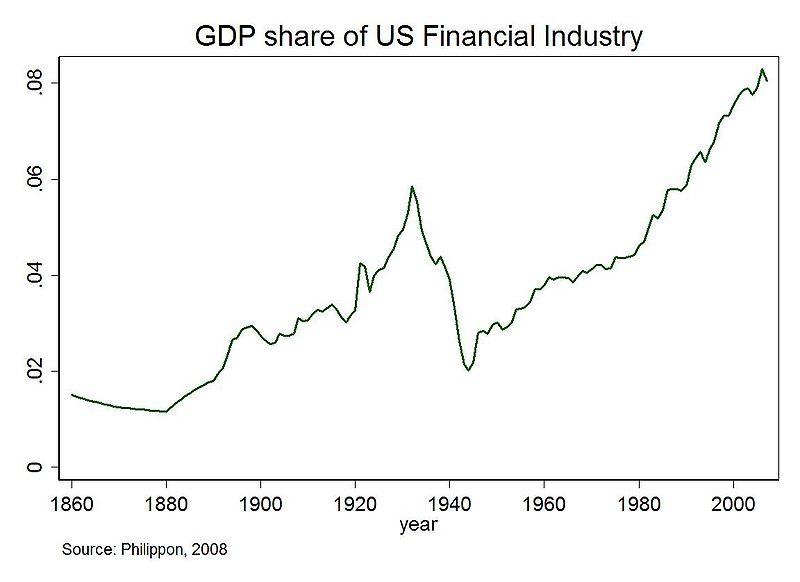
Why did the finance industry get so big? (guest post by Dan Murphy)


Dan Murphy is a fellow graduate student here at the University of Michigan, and will be going out on the job market next year. We were having a discussion about why the finance industry might have gotten so large in the U.S. in recent decades, and he decided to write up his thoughts on the subject, so here they are!

***

In an earlier post Noah solicited possible explanations for the increasing share of value added of the finance sector over the past half century, and especially the rapid increase in the 2000s.  I thought I’d throw a few ideas into the conversation.

To understand why the share of income received by finance has increased, it is first important to discuss how finance adds value and generates income.  I can think of three primary services that financial institutions provide:

1) Making Markets:  Financial institutions often act as a marketplace, matching buyers with sellers.  In return for this service the institutions charge a fee, and this fee is counted as their value added.  This function of financial institutions can be compared to the function of a farmers’ market that provides a centralized meeting place for farmers to trade their produce.  A group of people organize the market (find the location, provide tents and porta-pottys, etc), and in exchange the market organizers are paid a percentage of every transaction that takes place.  The organizers have an incentive to promote trade because their income is growing in the volume of transactions.  In the U.S. economy, financial institutions are the market organizers, and their income grows with the volume of transactions (GDP).  For example, credit card companies facilitate our purchases, and they earn a fee every time we buy something with a credit card.

2) Managing Risk:  This is really a specific subset of the first category, but it is an important enough function to warrant further discussion.  Financial institutions manage counterparty risk, and in exchange they are paid a fee (often referred to as a “haircut”).  More concretely, consider a wheat farmer (let’s name him Fred) who observes that the current price of a barrel of wheat is $10.  At that price he is willing to plant enough seeds for X barrels of wheat.  The problem for Fred is that the price of wheat may fall by the time of harvest, in which case he will wish that he hadn’t put in so much effort planting wheat.  Financial institutions can solve this problem for Fred by promising to purchase wheat from him for just under $10 at the time of the harvest.  Fred is willing to accept the slightly lower price in exchange for price certainty.

Meanwhile, consider a baker (let’s name him Ben) who purchases wheat to bake bread.  He can sell a loaf of bread for $5, and his profits from the sale depend on how much he must pay for the wheat.  Ben is happy when the price of wheat falls, and he very unhappy when its price increases.  Therefore he is willing to pay a small fee to guarantee that he will be able to purchase wheat for around $10 a barrel for the next year. Financial institutions help Ben by promising to sell him a barrel of wheat after a given amount of time for just over $10.  In doing so, they offset their risk exposure to their contract with Fred through their contract with Ben, and in the process they earn a fee.

3) Investment Intermediaries:  Financial institutions manage investments for clients and offer advice (on investing, planning for retirement, etc).  Many savers are willing to pay for these services because they a) believe that financiers have expertise that will earn them a higher return on their savings, and b) because they need an intermediary to help them purchase assets (if I want to buy gold (I don’t), presumably I’d ask a financial institution for help rather than walking around with cash and a wheelbarrow).

Borrowers pay financial institutions to help match them with willing lenders.  Often this takes the form of duration transformation, in which finance companies borrow from short-term savers to lend to borrowers over a long time horizon.  For example, financial institutions help cities issue long-term municipal bonds to pay for roads and schools.

Now that we’ve laid out some of the basic functions of the finance industry, let’s see if we can find a reason that its value added should increase so drastically.

Making Markets:  Based on our example above, it appears that the value added of making a market is in “greasing the wheels” of trade in goods and services.  If this is true the value added of financial institutions should grow in proportion to the growth of output (trade), holding constant the cost of greasing the wheels.  Of course the costs of facilitating trade have likely decreased over the past half decade.  Consider credit cards:  You may purchase the same amount of groceries as you did twenty years ago, but since your now use a debit card instead of a check, the cost to your bank of facilitating that purchase is much lower.  Could such cost-cutting increase the profit share of the finance industry?  If the banking services industry is noncompetitive, then perhaps, but even in this case it’s difficult to explain such a drastic increase, especially between 2000 and 2007.

Managing Risk: One reason that the value of risk management could grow more than the aggregate value in the economy is that as the economy grows, there is more risk to hedge.  For example, as aggregate income grows, consumers want to insure against more events in their lives (life insurance, for example).  Our ancient ancestors’ income was so low that it was all spent on food.  Since all adults spent their time hunting and gathering just enough to feed their own families, there were no “financiers” available to help people insure against a wolf killing the head of the household.  Contemporary Americans can produce food at much lower cost, and thus we can devote labor resources to managing insurance contracts.  But people have been able to insure against a range of events in their lives (floods, fires, death, etc) for decades, so I can’t imagine that an increase in demand for life insurance can fully account for the increase in the value of the finance industry.  It is true that firm-level risk has increased through the 80s and 90s (Diego Comin has done extensive research on this topic), and this increase in risk could correspond to higher demand for insurance.  But again, the acceleration in finance’s value added share in 2000 did not correspond to acceleration in idiosyncratic risk.

Investment Intermediaries:  Here I think is our answer for the rapid increase in the observed value added of the finance industry around 2000.  My guess is that the average person believes that financiers have superior knowledge of investing, and that this superior knowledge will earn them higher returns on their savings.  There are two primary effects that increase the computed share of value added attributed to the finance industry:  Fist, when returns are high, as had been the case in housing and stock markets until the recession, retail investors (and even pension funds) are less concerned about the fees they pay to fund managers (my wife didn’t know she paid fees, she just sees how much money is in her account, and if it’s more than the last time she looked, she’s happy.  I hear that some pension funds operate under similar rules of thumb).  If I give you $10, and you return me $20, I’m not overly concerned with the fact that you could have returned me $25 but instead kept $5 for yourself.  You tell me that you are special, and that you earned it, and I am happy enough that I just doubled my net worth that I don’t think twice, especially when other supposedly talented fund managers are also charging high fees.  This effect will be exacerbated when cash and bonds offer low returns while other assets (stocks, housing) offer sky-high returns because investors are even more likely to believe that the fund managers were special enough to earn higher returns than those offered by the savings account at the local credit union.

Note that this explanation does not require that we specify why returns for some assets are higher than others.  But I will simply suggest that if investors seek high yields by investing with managers who hold an appreciating asset (perhaps housing), that behavior could contribute to a price bubble and increase the share of value added attributed to the finance industry.  Interestingly, finance’s share of value added grew disproportionately along with the price of housing leading up to the recession in 2008 and fell during the recession.

Of course the high fees paid to financial intermediaries raise the following question:  Why has competition among financiers not prevented high fees from increasing their share of the returns to asset price appreciation?  In other words, if you reap a massive profit by charging me $5 to manage my money, why does someone else not offer to charge me $4?  One reason may be that you are Goldman Sachs, and you have established a reputation that you are worth the $5 (regardless of whether this is true). Since I don’t know the “true” value that your service adds, I simply assume that you are worth the $5.

Similar phenomena occur in other markets.  For example, I bought basketball shoes last week, and because I haven’t bought shoes in ages I have no idea which brand is the highest quality.  Nikes were $30 more expensive than what appeared to be a similar shoe from another brand.  Since Nike has established in my feeble mind a reputation for making quality basketball shoes (through advertising perhaps), I forked over the extra $30.

I have not had the opportunity to purchase services from Goldman Sachs (my piddly graduate student stipend essentially becomes cash temporarily stored under my mattress).  But I imagine that if I did have reason to do so, especially before the financial crisis, I might be willing to pay their exorbitant fees, especially if they are selling the opportunity to make money.  If Nike sells me the chance to dunk, I will gladly buy even if some Nike employee gets to dunk ten times as much.  Likewise, if Goldman sells me the opportunity to make more money at the cost of some money, I will buy even if doing so allows them to makes lots of money as well.

So yes, I do believe that some of the rising value of the finance industry is in its ability to efficiently facilitate trade and manage risk.  But another reason, which I would attribute to the acceleration in the growth of finance’s value added and profit shares around 2000, is likely due to the financiers’ ability to sell their services, an ability that grows in strength when certain assets are appreciating because investors are willing to pay to hold appreciating assets.  If this appreciation is due to technological improvements, as in the 90s, then investors are, over time, benefiting from the financial services, even if at a high price.   But if the appreciation is due to a bubble, or to expected economic growth that does not materialize, then the incomes in the finance industry will increase without a corresponding increase in aggregate income, translating into a rapid rise in the finance industry’s observed share of value added.  
reade more... Résuméabuiyad