Pages

.

Thoughts on the Derbyshire racist rant


Well, I kept trying to think of a coherent argument to make about John Derbyshire's racist rant, but everything I thought of was either too obvious ("racism is bad, mmmkay!") or so beside-the-point that it risked distracting people from the badness of the racism. So instead of a single long post, I thought I'd list a few loosely connected thoughts I had in response to the rant.


1. Derbyshire really is racist, and his racism really is dumb.

Intelligent racists these days tend to defend their bigoted statements by prefacing them with a disclaimer that "What I say is only true on average," or "This is just a statistical tendency." Derbyshire does the same thing at the beginning of his rant. But then he goes on to make prescriptive statements about individuals based on those "statistical tendencies"! He goes from "On average, black people are more violent" to "If you see black people, you should avoid them."

This is a statistical and logical fallacy, as any researcher knows. Descending into nerdspeak for a moment, statistical significance is not the same thing as effect size. In plain English, this means that whether a person you see on the street is black is not a useful indicator of how likely they are to attack you. There are much better ways of predicting who is likely to be violent, just from looking at them.

For example, take  a look at these two screenshots (the former from the movie Boyz n the Hood, the latter from the TV show Community):

Screenshot A

Screenshot B

If you're walking around and see people who look like the guys in Screenshot A, you might reasonably want to avoid them (though actually I wouldn't, but save that for later). Why? Not because they're black! Because they look poor, tough, and mean. Those would be good reasons to avoid someone who looked like Ice Cube looks in Screenshot A. Their blackness would be beside the point. It would not be an important consideration, on top of the other things you could already see. If they were Vietnamese, there would be absolutely no less reason to avoid avoid them.

Conversely, if you see some guys who look like the guy in Screenshot B, you would have no good reason to avoid them. Troy from Community looks like an even-tempered middle class guy - a guy who is highly unlikely to attack anybody. The fact that he's black makes no difference at all. If you go around avoiding guys who look like Donald Glover in Screenshot B, you aren't being prudent, you're just being an idiot...you're like one of those OCD kids who never steps on cracks in the sidewalk, except that instead of simply looking like a doofus, you're making people uncomfortable.

To put this another way: Suppose you see a bunch of rowdy-looking, tough-looking 18-year-old guys swaggering down the street in a poor neighborhood. Do you think to yourself, "Oh, if those guys were white, I'd go up and ask them for directions, but since they're black, and because I have this theory about ancient African evolution making black people more violent, I know they're likely to be violent, so I'll avoid them."??? No. No you do not. Because you are, hopefully, not an idiot.

So it's easy to see that the "statistical tendency" of black Americans to commit more violent crime should have no implications for behavior toward individuals. Violent people of any race are easy to spot. This directly contradicts Derbyshire's admonishment to avoid black people. If they follow their dad's racist advice, Derbyshire's kids are just going to look like idiots and be socially ostracized, without actually being any safer.


2. I actually find poor black people less scary than their white counterparts.

Here's my personal background. I grew up in College Station, Texas, which in the 80s was a highly conservative, mostly white town with a small, mostly poor black population. My neighborhood was next to the neighborhood where the poor black people lived, so I rode the same bus as them. There were a smaller number of white kids on our bus, mostly lower-middle-class Southern whites.

The black kids on my bus never once bothered or threatened me. They clearly had a culture that was very different from mine, including a very different dialect of English (which I eventually learned to understand). But they never tried to bully me, and never acted unfriendly toward me (they would always let me sit next to them, and usually would let me have the window seat so I could read a fantasy book or sleep).

The same was not true of the Southern white kids. They were also very culturally different from me (I was a nerdy Jewish kid with Northern parents and no Texas accent). While the black kids were on the bus, the Southern white kids would be sullen and silent, but as soon as the black kids got off, the white guys would start trying to bully me. They were definitely aggressive and targeted me, other non-Southern whites, and Asians.

I asked my mom why this was the case, and she shrugged and said something like "Maybe it's because the KKK hates black people and Jewish people!" I thought that sounded a little far-fetched (though the Southern white kids often spoke approvingly of the KKK when there were no black people around!). I came up with a different hypothesis: I was too different from the black kids for them to see me as a threat or competitor. People usually don't just attack strangers just out of pure sadism; they assert their dominance over competitors. To the black kids, I was just some kind of interesting oddity; to the Southern white kids, I was a white kid of a different tribe, and one who needed to be reminded of his place.

This pattern has repeated itself in other times and places. In California, in Japan, and now in Michigan, I've found that black people never want to fight me, but white people sometimes do. Although I generally avoid people who look tough, poor, and violent (see Thought #1), I sometimes break this rule for nonwhite people. Once or twice, I've gone up and started chatting with "gangster"-looking black dudes on the streets of Tokyo and Detroit, and they turned out to be pretty friendly. Now I'm not stupid - if I do that 1000 times I know I'm eventually likely to get mugged - but I wouldn't even try asking directions from a bunch of drunk rowdy-looking white guys walking down the street in Ann Arbor.

Who knows, maybe it was just the school bus that made me who I am.


3. I think Derbyshire-style racism really is holding back black people in America.

The disappearance of explicit racial discrimination in American public life has convinced a lot of people that racism is no longer holding back black people. I disagree.

An outsized percentage of black people in America are poor. Because of the cultural pathologies that stop American poor people from forming stable families (see Daniel Patrick Moynihan's 1965 report on poor blacks or Charles Murray's recent book on poor whites), this means that an outsized percentage of young black men are going to be violent. And given the prevalence of gun ownership in America, violence here is very dangerous.

This puts Americans in great danger of committing Derbyshire's Fallacy - of assuming that race is a good proxy for violence. Many white and Asian Americans share Derbyshire's fear of associating with black people. This means that white and Asian Americans are less likely to have black friends, which means that black people are often frozen out of networks of business and professional connections. That makes it harder for black entrepreneurs to embed themselves in existing white and Asian networks of customers, suppliers, and business partners. It means that black employees will have fewer white and Asian connections when they are looking for a job.

The separation of black networks from white networks will keep black people poor. And black people's poverty will keep causing people to indulge in Derbyshire's Fallacy. It's a stable equilibrium.

How do we break out of that equilibrium? I'm pessimistic, because I know how easy it is to assign race an outsized importance when making judgments of people. If someone cuts you off on the freeway, your first thought probably isn't "Oh, that incompetent driver!", it's "Oh, that old person!" or "Oh, that Hispanic person!" or "Oh, that woman!", etc. We humans are hard-wired for tribalism, not Bayesian rationality.

There are, however, some things we can do. One is to continue to admit lots of nonwhite immigrants. Asia has a lot of these. Just getting rid of the notion that white Americans are "the real America" should go a long way toward eliminating the deeper, more dangerous racism left over from the old Confederacy. When admitting immigrants from Africa, we should make sure to especially focus on high-skilled immigrants in fields like engineering, computer science, etc. There is no shortage of these, as the burgeoning numbers of Nigerian, Ghanaian, Ivorese, and Senegalese electrical engineers and software engineers at American universities demonstrates. It's hard to argue that black people are dumb when you need to ask their help on your semester project.

Also, we should just do sensible things like ending the drug war, breaking up concentrations of poverty in inner-city government housing projects, etc.

And finally, there's urban policy. America is caught between a suburban/exurban racially-segregated past that is no longer economically feasible, and a dense urban/suburban future that is being stymied by low funding for public transportation, and by zoning regulation (see Matt Yglesias). The faster we manage the transition to the new urban America, the sooner Americans will be forced to live around people of all races. When that happens, people will learn that it makes sense to identify dangerous people by their clothes and attitude and behavior, not by their race.

Well, hopefully.
reade more... Résuméabuiyad

John Derbyshire's racist rant, preserved in full

It occurred to me that Taki's Magazine might take down John Derbyshire's racist rant after all the negative attention it has justly received. So I decided to cut and paste it here, to preserve it for posterity, so people can see the kind of things that racists say when they're being honest:

There is much talk about “the talk.”  
“Sean O’Reilly was 16 when his mother gave him the talk that most black parents give their teenage sons,” Denisa R. Superville of the Hackensack (NJ) Record tells us. Meanwhile, down in Atlanta: “Her sons were 12 and 8 when Marlyn Tillman realized it was time for her to have the talk,” Gracie Bonds Staples writes in the Fort Worth Star-Telegram.  
Leonard Greene talks about the talk in the New York Post. Someone bylined as KJ Dell’Antonia talks about the talk in The New York TimesDarryl Owens talks about the talk in the Orlando Sentinel 
Yes, talk about the talk is all over.  
There is a talk that nonblack Americans have with their kids, too. My own kids, now 19 and 16, have had it in bits and pieces as subtopics have arisen. If I were to assemble it into a single talk, it would look something like the following.  
* * * * * * * * * * * * *  
(1) Among your fellow citizens are forty million who identify as black, and whom I shall refer to as black. The cumbersome (and MLK-noncompliant) term “African-American” seems to be in decline, thank goodness. “Colored” and “Negro” are archaisms. What you must call “the ‘N’ word” is used freely among blacks but is taboo to nonblacks.  
(2) American blacks are descended from West African populations, with some white and aboriginal-American admixture. The overall average of non-African admixture is 20-25 percent. The admixture distribution is nonlinear, though: “It seems that around 10 percent of the African American population is more than half European in ancestry.” (Same link.)  
(3) Your own ancestry is mixed north-European and northeast-Asian, but blacks will take you to be white.  
(4) The default principle in everyday personal encounters is, that as a fellow citizen, with the same rights and obligations as yourself, any individual black is entitled to the same courtesies you would extend to a nonblack citizen. That is basic good manners and good citizenship. In some unusual circumstances, however—e.g., paragraph (10h) below—this default principle should be overridden by considerations of personal safety.  
(5) As with any population of such a size, there is great variation among blacks in every human trait (except, obviously, the trait of identifying oneself as black). They come fat, thin, tall, short, dumb, smart, introverted, extroverted, honest, crooked, athletic, sedentary, fastidious, sloppy, amiable, and obnoxious. There are black geniuses and black morons. There are black saints and black psychopaths. In a population of forty million, you will find almost any human type. Only at the far, far extremes of certain traits are there absences. There are, for example, no black Fields Medal winners. While this is civilizationally consequential, it will not likely ever be important to you personally. Most people live and die without ever meeting (or wishing to meet) a Fields Medal winner.  
(6) As you go through life, however, you will experience an ever larger number of encounters with black Americans. Assuming your encounters are random—for example, not restricted only to black convicted murderers or to black investment bankers—the Law of Large Numbers will inevitably kick in. You will observe that the means—the averages—of many traits are very different for black and white Americans, as has been confirmed by methodical inquiries in the human sciences. 
(7) Of most importance to your personal safety are the very different means for antisocial behavior, which you will see reflected in, for instance, school disciplinary measurespolitical corruption, and criminal convictions.  
(8) These differences are magnified by the hostility many blacks feel toward whites. Thus, while black-on-black behavior is more antisocial in the average than is white-on-white behavior, average black-on-white behavior is a degree more antisocial yet.  
(9) A small cohort of blacks—in my experience, around five percent—is ferociously hostile to whites and will go to great lengths to inconvenience or harm us. A much larger cohort of blacks—around half—will go along passively if the five percent take leadership in some event. They will do this out of racial solidarity, the natural willingness of most human beings to be led, and a vague feeling that whites have it coming.  
(10) Thus, while always attentive to the particular qualities of individuals, on the many occasions where you have nothing to guide you but knowledge of those mean differences, use statistical common sense:  
(10a) Avoid concentrations of blacks not all known to you personally.  
(10b) Stay out of heavily black neighborhoods.  
(10c) If planning a trip to a beach or amusement park at some date, find out whether it is likely to be swamped with blacks on that date (neglect of that one got me the closest I have ever gotten to death by gunshot).  
(10d) Do not attend events likely to draw a lot of blacks.  
(10e) If you are at some public event at which the number of blacks suddenly swells, leave as quickly as possible.  
(10f) Do not settle in a district or municipality run by black politicians.  
(10g) Before voting for a black politician, scrutinize his/her character much more carefully than you would a white.  
(10h) Do not act the Good Samaritan to blacks in apparent distress, e.g., on the highway.  
(10i) If accosted by a strange black in the street, smile and say something polite but keep moving.  
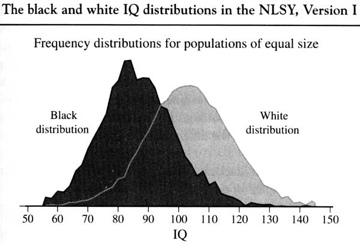
(11) The mean intelligence of blacks is much lower than for whites. The least intelligent ten percent of whites have IQs below 81; forty percent of blacks have IQs that low. Only one black in six is more intelligent than the average white; five whites out of six are more intelligent than the average black. These differences show in every test of general cognitive ability that anyone, of any race or nationality, has yet been able to devise. They are reflected in countless everyday situations. “Life is an IQ test.”  
(12) There is a magnifying effect here, too, caused by affirmative action. In a pure meritocracy there would be very low proportions of blacks in cognitively demanding jobs. Because of affirmative action, the proportions are higher. In government work, they are very high. Thus, in those encounters with strangers that involve cognitive engagement,ceteris paribus the black stranger will be less intelligent than the white. In such encounters, therefore—for example, at a government office—you will, on average, be dealt with more competently by a white than by a black. If that hostility-based magnifying effect (paragraph 8) is also in play, you will be dealt with more politely, too. “The DMV lady“ is a statistical truth, not a myth.  
(13) In that pool of forty million, there are nonetheless many intelligent and well-socialized blacks. (I’ll use IWSB as an ad hoc abbreviation.) You should consciously seek opportunities to make friends with IWSBs. In addition to the ordinary pleasures of friendship, you will gain an amulet against potentially career-destroying accusations of prejudice.  
(14) Be aware, however, that there is an issue of supply and demand here. Demand comes from organizations and businesses keen to display racial propriety by employing IWSBs, especially in positions at the interface with the general public—corporate sales reps, TV news presenters, press officers for government agencies, etc.—with corresponding depletion in less visible positions. There is also strong private demand from middle- and upper-class whites for personal bonds with IWSBs, for reasons given in the previous paragraph and also (next paragraph) as status markers.  
(15) Unfortunately the demand is greater than the supply, so IWSBs are something of a luxury good, like antique furniture or corporate jets: boasted of by upper-class whites and wealthy organizations, coveted by the less prosperous. To be an IWSB in present-day US society is a height of felicity rarely before attained by any group of human beings in history. Try to curb your envy: it will be taken as prejudice (see paragraph 13).  
* * * * * * * * * * * * *  
You don’t have to follow my version of the talk point for point; but if you are white or Asian and have kids, you owe it to them to give them some version of the talk. It will save them a lot of time and trouble spent figuring things out for themselves. It may save their lives.
I may write a post later actually commenting on the rant. For now, it's enough simply to make sure that people are able to read this bullshit and see for themselves what is going through the mind of the American racist.


Update: As always, my Arbitrary Comment Deletion Policy is in full effect. I especially frown on comments that contain hate speech, personal insults, or incitement to violence.


Update 2: Here, as promised, are some of my thoughts about the rant.
reade more... Résuméabuiyad

Thursday Roundup on Wednesday (4/5/2012)


This week's Thursday Roundup (which comes on a Wednesday) will NOT include any links to the turgid and impenetrable Keen/Krugman/Rowe debate on the role of the banking sector! It will also not include any rabid weasels on PCP. Or hot tips on overlooked Chinese stocks. Or pictures of Jon Steinsson in a mankini. If I had the latter, they would be safely hidden on my hard drive in a little out-of-the-way folder labeled "temp". And no, I would not email them to you, so stop asking.

1. FT Alphaville has a great comparison of Japanese 1990s deleveraging and American 2010s deleveraging. Long story short: Japanese companies had to work off their debt then, while it's American households now. Of course, Japanese people's companies are supposed to be like family, so maybe it's the same thing? ;-)

2. Fareed Zakaria notes that America now imprisons more people than Joseph Stalin. That's right, more than Stalin. Of course, many of Stalin's prisoners died, while America's just get raped. Moral equivalence disproven thus!

3. Paul Krugman discusses political/social constraints faced by the Fed chairman. Anyone who believes in an omnipotent Fed - and I know you're out there, because I have a special elven crystal that shines in the presence of monetarists! - should read this and consider it deeply.

4. Karl Smith thinks that maybe resource booms can create substantial numbers of jobs after all. The reason? Large inter-industry multiplier effects. Here is a Chad Jones paper that illustrates this idea in a development-econ context, but the analysis seems like it could apply to mature economies as well. Note: this may be a heretofore theoretical example of Paul Krugman being wrong about something, but we won't know for sure until the next generation of particle detectors comes online...

5. David Beckworth discusses fiscal policy in terms of safe assets, not aggregate demand. This seems very similar to Brad DeLong's viewpoint. My own intuition is that risky assets will have to be brought into the picture in order to analyze the differences between the market for safe assets and the market for goods and services. Also, that bears are really awesome.

6. Matt Yglesias points out that institutional investors who hand over their money to hedge funds have been throwing their money in a toilet. And why not? If I can make a 20% return and without me you can only make a 7% return, why should I charge you any less than 13% for my services?

7. Two political scientists write an article in which they pooh-pooh the idea that social science theories should have "empirical support," and instead think that we should simply sit and think and deduce how people behave, and then believe in our own deductions. That is, to use KNZN's term, they believe social science should embrace the bullshit. Hmm...what's that smell? (Update: Sean Carroll intellectually pulpifies the folks who wrote the article. WABAMMM)

8. Matt Yglesias takes down David Graeber's absurd idea that China is paying "tribute" to the U.S. by buying our bonds. And he does so without using extreme sarcasm ("loansharks are paying tribute to gambling addicts!"). Is Matt going soft in his old age?

9. Menzie Chinn makes an important observation: All the people talking about a "GDP-less recovery" were talking about a "jobless recovery" just a year earlier. Averaged over the recession, Okun's Law has held up perfectly well! Who says macro doesn't have well-observed heuristic laws and empirical constants?

10. Tyler Cowen conjectures that we will finally stop replacing robots with Chinese people and start replacing Chinese people with robots, leading to a U.S. export boom. Ryan Avent critiques the idea. Personally, I predict that AIs will spend most of their time making the lives of Scottish geeks even more miserable, but maybe I just read too much Charles Stross.

11. Ryan Avent plumps for higher inflation. Should we forget the "lessons" of the 70s? Maybe we should! Avent also argues that maybe, just maybe, lower wages might be a good thing in a recession...DESTROY HIM, JW Mason! (giggles maniacally)

12. A blogger at Econospeak points out that while some conservative economists (Ed Lazear) are saying that economic growth is much slower than potential, others (Martin Feldstein) are saying that the output gap is close to zero, and we are thus in danger of inflation. Now, conservatism is not a hive mind, so this is not an internal contradiction, but it seems suspicious...how likely are conservative economists to simply start from a conclusion ("Democratic presidents are bad for growth", or "inflation is imminent") and then simply look around for rationales to support those conclusions? (Cue "liberal socialist commies are even worse, durr hurr!" comment in 3...2...1...)

13. Peter Dorman asks a good question about risk vs. uncertainty: what's the difference between a fair coin and a potentially loaded coin? Some people, including people who do experiments on "uncertainty aversion," assume there is no difference, since a priori a coin seems just as likely to be loaded heads as to be loaded tails. However, in a Bayesian context, there is a difference, since in the loaded case people can have priors as to whether heads-loading or tails-loading is more likely. Could this be a case in which Bayesian probability theory and classical probability theory have different implications for human behavior? I think it very well could be...

14. Tyler Cowen claims that the "unraveling" of bloated state sectors in European countries will cause short-term economic pain. Perhaps we can get a debate going between Cowen and John Cochrane, who says the opposite. Oh who am I kidding. Everyone knows "Tyler Cowen" and "John Cochrane" are just sock puppets for a distributed-consciousness AI that evolved from Usenet.
reade more... Résuméabuiyad

Adobe takes Web Experience Management to the next level

Adobe CQ 5.5 makes it easy to preview mobile-device content layouts on any of hundreds of popular devices.
The new release of Adobe's Web Experience Management solution, otherwise known as Adobe CQ Web Content Management 5.5, is out, and it's a major new release. The release cycle for this particular version of Adobe CQ started March 1, 2011 and went through 25 iterations of quality assurance, bug fixes, and testing, ending February 20, 2012. The total number of customer related issues addressed in this release was 296.

In case you're not familiar with Adobe CQ WCM 5.5, this is the product formerly known as Day Communique (used by McDonalds, Mercedes, and other Fortune 500 customers to manage their web properties). It's a unified web content management suite designed to let digital marketers create, manage, deploy, and optimize online experiences across Web, social, and mobile channels, typically in multiple languages, across multiple geos.

Add-on modules provide extended functionality for Multi-Site Management, Marketing Campaign Management, Mobile and tablet support, plus Social Collaboration, including Blogs, Forums, and Calendaring.

An important complement to Adobe CQ WCM 5.5 is Adobe CQ DAM 5.5, which is a digital asset management system for enterprise-level organizations that need to manage non-trivial quantities of media assets with complex and diverse uses for different target audiences.

A year ago, Adobe rolled out some initial integrations between Adobe CQ and the Omniture-based SiteCatalyst and Test&Target products. With CQ5 5.5, this integration has deepened, with additional integrations to other Adobe products, most notably:
  • Creative Suite: Adobe’s flagship software now integrates seamlessly with CQ5.5’s Digital Asset Management (DAM) via Drive or Bridge. Creative teams can now adjust a photo, push it directly to the web, and then get analytic feedback on how photo versions are performing—all without ever leaving Creative Suite.
  • Scene7:  The integration with CQ 5.5 has made it much easier for companies in retail, hospitality, travel, or CPG to take advantage of Scene7’s dynamic personalization capabilities.
  • Search & Promote: Site search components now come out-of-the-box (as long as you’ve bought a Search & Promote license). This is an interesting integration since the convenience of adding faceted search to your site via a drag-and-drop UI is quite compelling.
  • SiteCatalyst and Test&Target: While an integration with these two former Omniture products existed in 5.4, the presentation layer in 5.5 is now more intuitive and plays nicely with the personalization features.
A more detailed overview of the integration with Adobe Online Marketing Suite can be found here.

I'll expand on some of the specific improvements made to Adobe CQ 5.5 in a followup blog post, but in the meantime, if you're anxious to drill down on some of the particulars, you might want to take a quick glance at the Release Notes.

Meanwhile, the product's complete online documentation is here.


reade more... Résuméabuiyad

A monetary policy Pascal's Wager


In the 1600s, French philosopher-mathematician Blaise Pascal made the following argument for believing in God: "If I believe in God, and I'm right, I'll go to Heaven, which is infinitely awesome. But if I don't believe in God, and I'm wrong, I'll go to Hell, which is infinitely bad. Therefore, it makes sense to believe in God." Any economist will recognize this as being an expected utility calculation - even if there is only a tiny chance that God is real, the expected utility of believing in God is still infinitely higher than the expected utility of not believing in God. So believe in God, ye rational agents!

The problem is, as you probably figured out before you even finished reading that paragraph, is that it assumes that you only have two choices - Christianity and atheism. Suppose we also introduce Islam. Suppose the Christians say "If you believe in Jesus you'll go to Heaven; if not, Hell." And suppose the Muslims say "If you believe in Allah you'll go to Heaven; if not, Hell." Call this the Two-Sided Pascal's Wager. Well, in this case, your expected utility is undefined no matter which religion you choose. And you can't choose both! You are basically screwed. Maybe you end up choosing one or the other, but you always reserve the right to switch.

So what does this have to do with monetary policy, you ask?

Via David Glasner, I see that John Taylor is now pushing the idea that the Great Recession of 2009-whenever was caused by too-high interest rates in 2008 (which were in turn necessitated by too-low interest rates earlier in the decade). Taylor has repeatedly stated that "too high" and "too low" are to be measured relative to his Taylor Rule

This is interesting, because it means that Taylor believes that the Fed's decisions have absolutely enormous power over the macroeconomy. I know Suppose, hypothetically, that I know someone else who believes the same thing: Scott Sumner just for fun let's call him "Scott Sumner" (Update: This does not seem to characterize Scott Sumner's actual position. See bottom of post. For now, go with the hypothetical.). Also, Suppose both Taylor and Sumner appear to believe that Fed commitment to an optimal monetary policy rule is essential to prevent large recessions. And each economist has a very specific idea of what that optimal rule should be.

Here's the weird thing, though: Their rules are different rules.

Taylor basically says: "If the Fed does not credibly commit to a Taylor rule with coefficients of 1.5 and 0.5, the economy will experience big recessions and/or big inflations."

Sumner basically hypothetically says: "If the Fed does not credibly commit to NGDP level targeting to keep NGDP on a 2% 5% growth path, the economy will experience big recessions and/or big inflations."

So suppose you are a central banker, and you are very very risk-averse. You absolutely dread big recessions and big inflations. If you pick the wrong monetary policy rule, you're absolutely screwed. But you also have model uncertainty; you don't know for sure whether Taylor's story or Sumner's story perfectly describes the world.

Well, since you're risk-averse, you'd ideally like to choose a mix of the two rules. You'd like to buy insurance. But you can't buy insurance, because there is no way to mix the two rules! Both Taylor's and Sumner's models each insist that for the policy to work, there can be no wavering from firm commitment to the rule. Your choice set is convex.

In this case, Taylor's and Sumner's dueling propositions look very much like a Two-Sided Pascal's Wager between Christianity and Islam. You are a risk averse agent faced with a convex choice set over two high-risk alternatives, with no low-risk alternative available. In other words, you are screwed.

This is why I think that economists who advocate models in which A) small monetary policy mistakes have severe negative consequences, and B) commitment is crucial are, ironically, doomed to failure by the extreme nature of their own arguments. The central bank operates under a great deal of model uncertainty, and is highly risk-averse. Unless it is extremely confident of one single model of the macroeconomy, the Fed will choose discretion (or a model like Woodford's, in which deviating from the rule does not come at a huge cost) rather than the kind of rigid commitment advocated by economists like Taylor. Which is to say, even if the Fed picks a rule, it will reserve the right to modify or drop that rule if conditions seem to warrant, just like a person reserves the right to change their religion. And since people know that the Fed reserves that right, they will never believe that the Fed will ever fully commit to any rule. Which means that no rule that requires absolute commitment can work.

This leaves discretion as the only feasible policy. The Two-Sided Pascal's Wager is a wager you just can't win.

Update: Commenters, including Scott Sumner, have suggested that the position I initially attributed to Sumner is more characteristc of economists other than Sumner. If so, I apologize for mischaracterizing Sumner's opinion, but really I was just trying to use any example in order to demonstrate the general principle.

Update 2: In a Twitter discussion, Andy Harless raises the possibility that Fed commitment to any rule might dominate pure discretion. Scott Sumner (I think) puts forth the same idea in the comments. Fair enough. That could be true! But, given that John Taylor disagrees - that he thinks that any non-Taylor rule will spell disaster - and given that the Fed gives Taylor's ideas nontrivial levels of credence, my point still holds!

Update 3: In the aforementioned Twitter discussion, I said:
My point is that if the Fed gives Taylor ANY credence, no one else will persuade the Fed to commit firmly to a non-Taylor rule...Let me put my point more informally: Taylor probably scares the Fed away from credibly committing to ANY non-Taylor rule...just by invoking Hell, Taylor is FORCING a Pascal's Wager on the Fed, regardless of what [any other economist] does or who is right.
That should clear things up, for those who found the above discussion a bit dense.
reade more... Résuméabuiyad

Why should China innovate when it can just steal?


Another day, another "Can China innovate?" story popping up in my Twitter feed. This is a beast of the same family as the "Prepare for a wave of Chinese innovation" article and the "America can only stay ahead if we innovate" article. But I never see anyone asking this question:

Why should China bother with innovation when it can just steal technology?

When I was but a lad, I used to play a game called Master of Orion II. In this game, as the leader of a star empire, you can research new technologies. You can also hire spies to go steal technologies from your competitors. Spies are cheap and quick. If your species has an advantage in spying, it almost doesn't make sense to pour your resources into research; instead, you can just steal everything you need, and put your people to work building warships instead of peering through microscopes. There's only one problem with this strategy - it makes all the other races of the galaxy declare war on you.

China is not in any danger of having the rich countries of the world declare war on it. It also has an advantage in spying, given its large and well-educated population (which results in many Chinese nationals in grad school or working as engineers in rich countries). So it's not surprising that life imitates Master of Orion II - China does a huge amount of spying and steals a huge amount of technology.

Does it make sense for China to do this? Given that it's not in danger of physical attack, the only downside to this strategy would be if A) rich countries retaliated by restricting trade with China, or B) Chinese espionage actually reduces the amount of innovation that goes on in the world. Are either of these downsides scary enough to make China stop its espionage?

Trade protectionism as retaliation for spying is probably not a danger. First of all, spying is hard to measure, making it hard to know when to end the punishment (maybe the spies just laid low until the tariffs were lifted!). Second of all, the protectionism would probably have to be coordinated among rich nations, and that is notoriously hard to do, especially given the collateral damage that might be inflicted on the economies of the rich countries.

So could Chinese espionage cause a global innovation slowdown? Innovations are a mostly nonrival good, so a company has no incentive to innovate if it can't partially monopolize its innovations. Hence, in a world where China just steals everything, companies might as well just not innovate. Since companies are responsible for a substantial portion of the innovation in the world, this would be bad for China, since it would slow global economic growth, reducing demand for China's exports, investment into China, etc. It would also "kill the goose," forcing China to either rely on domestic innovation or accept slower productivity growth.

(Now of course, in the real world, the question I've posed - "Should China innovate OR steal?" - is silly. It's not an either-or question. China faces an allocation decision - it has to decide how many of its smart people it wants to send overseas to steal stuff from rich countries, and how many it wants to put to work discovering new things. The costs of spying, which I described above, are in addition to the opportunity cost of research manpower that China incurs from its espionage activities. Spying probably has diminishing returns in the number of spies. Also, the return to spying probably falls as your country catches up technologically with the country you're ripping off; the fewer things there are to steal, the harder it is to steal each one.)

But is "killing the goose" really a cost for China? Remember, saying "China does this" and "China wants that" is really a misnomer, since China is not monolithic. If we're talking about the Chinese government, it may be that the government cares about China's relative power in addition to its absolute wealth. There are some indications that China's leaders have this mindset. In this case, spying becomes more attractive relative to research. Do you care if you cause a global innovation slowdown, if that slowdown hurts your rivals more than you? To the extent that rivalry matters to you, you don't care. You spy more and research less.

Another point: Espionage and innovation are not the only ways to acquire technology. China can also force foreign companies to give it technology in exchange for access to its huge domestic market. Even if U.S. and European companies end up losing out in the long run from this kind of deal, the short-term pressures of the stock market (which determines executive compensation) may force companies to do this. Unsurprisingly, China has been doing some of this too.

So, back to the beginning of the post. Instead of considering the question of Chinese innovation in isolation, we should consider the totality of ways that China can acquire technology to continue raising its productivity. We should not be asking "Can China innovate?", but rather "Can China innovate, steal, and/or force foreign companies to transfer technologies to China in exchange for market access?" Anyone who is rooting for China's economy should not be so worried by the innovation limitations discussed in articles like this one, unless they also believe that China's demonstrated capacity for forced tech transfer and espionage are also diminishing.

One more point. Economists are beginning to take seriously the idea that we are in a Great Stagnation. They should think about whether the rate of technological progress is being impacted by Chinese espionage and forced technology transfer.
reade more... Résuméabuiyad

Is economics BS? A response to a KNZN

I'm a Not-So-Angry Bear...

Wow, people other than the barristas at my local Starbucks know who I am! KNZN names me "The Bearish Smith". Compared to Karl that may be true, but compared to Yves I'm a ray of sunshine...

Anyway, KNZN (whose moniker, I am assuming, is an acronym for "Korea/New Zealand National", reflecting his unique heritage) goes on to say some very pessimistic things about macroeconomics:
But another post to which I was referred by the Bearish Smith’s blog leads me to think about the issue of macroeconomics as a field... 
Here’s my take: to begin with, economics is basically bulls**t... 
Economics is bulls**t because it relies on the premise that human beings behave in a systematic way, and they don’t. Once you have done enough research to convince yourself that they behave in a certain way, they will change and start behaving in another way. Particularly if they read your research and realize that you’re trying to manipulate them by expecting them to continue behaving the way they have. But even if they don’t read your research, they may change the way they behave just because the zeitgeist changes – cultural sunspots, if you will.
The last paragraph may vaguely remind you of the Lucas critique. Lucas basically said that macroeconomics (as it was being practiced at the time) was bulls**t, but he held out the hope that it could receive micro-foundations that wouldn’t be bulls**t. 
The problem with Lucas’ argument, though, is that microeconomics is also bulls**t. And Noah Smith, writing some 36 years after the Lucas critique and observing its unwholesome results, takes it one step further by saying, if I may paraphrase, “Yes, the microeconomics upon which modern macro has now been founded is indeed bulls**t, but if we do the micro right, then we can come up with non-bulls**t macro.” 
Yeah, I doubt it. Maybe we can come up with slightly better macro than what we’ve got now, but the underlying micro is never going to be right. Experimental results involving human subjects are inevitably subject to the micro version of the Lucas critique: once the results become well-known, they become part of a new environment that determines a new set of behavior. And the zeitgeist will screw with them also. And so on. And in any case, even if the results were robust, I’m skeptical that we can really build them into a macro model or that it would be worth the trouble even if we could. Economics will always be bulls**t.
Wow! After calling me bearish, KNZN out-bears me by several Standard Bearishness Units! I've written quite a lot on the less-than-ideal state of macroeconomics, but I feel a need to defend my optimism about the (potential) future of the discipline. As KNZN says, I really do think that better micro will help us do better macro.

First, let's look at this "cultural sunspots"/"zeitgeist" argument. Stuff like that may happen, but it just means we need to keep updating our data and our models as cultural conditions change. Maybe the change happens faster than science can keep track of it (in which case we definitely are in trouble) but I don't think anyone really knows if that is the case. To assume science can't keep up seems to me like unreasoning pessimism.

And maybe cultural change isn't driven by sunspots at all! Maybe it's predictable. For example, things like fertility transitions, urbanization, and the shift from manufacturing to services all seem pretty universal, and these things may have predictable effects on culture. In fact, from seeing Japan, my bet is that this is the case. And perhaps things like financial crises, globalization waves, and debt supercycles change consumption/saving/investing behavior in long-lasting and predictable ways. I would not be surprised. 

I'm just generally very leery of the idea of "culture" as an inexplicable, chaotic force that makes economics hopeless.

Next, there is the idea that microeconomics is subject to a Lucas critique. I.e., that trying to exploit models of human behavior leads to changes in that behavior. This is two uber-pessimistic claims in one: 1) the claim that psychology is also bullshit and rather than science, and 2) the claim that market structure imposes no regularity on market outcomes.

First, psychology. Maybe it's because I'm the son of a cognitive psychologist, but I am highly skeptical of this claim. People have limitations on how much information they can process; telling them that you know this is not going to suddenly turn them into supercomputers. Furthermore, people have norms and values. Telling people that you know they think something is fair will not make them suddenly think it's unfair. Yes, some behavioral regularities disappear when you try to exploit them, but not all

Case in point: the lottery. The lottery is a reliable way for a government to make lots of money. So far it has never failed. And it relies on human behavioral regularities; it's easy to imagine a species that wouldn't play the lottery. But we know that we are humans, and we know that humans like to play the lottery, so the government can run lotteries and get money again and again and again. That's microeconomic technology in action.

But microeconomists don't just study psychology, they study markets. The structure of markets makes a big difference. For example, continuous double auction markets very reliably produce the law of one price, while bilateral trade negotiations do not. That is a robust result! It doesn't go away when you tell people about it. And it doesn't seem to depend on people's preferences. Other examples come from auction theory; everyone knows that auction theory exists now, and yet that hasn't made the theory's predictions suddenly start to fail. 

These are examples of outcomes that are predicted by theory and confirmed by experiment. That's called "science"! You can say "Well, maybe these things will go away tomorrow," and yes logically that is true, but that is true for any science, including physics. There's no guarantee that what holds today will hold tomorrow. Science rests on the assumption that the mechanisms of the Universe are stable. When that assumption fails, science fails. But I see no good reason to assume that this assumption always fails for economics. If you're just a pessimist, fine. But I'll need more convincing!

And there are LOTS of areas where we have barely begun to even study micro behavior. One big example is the behavior of firms. We don't understand this very well. In most macro models that you see today, the behavior of firms is even more hopelessly stylized and unrealistic-seeming than the behavior of consumers. A second, rather obviously, is financial markets. We need a lot better understanding of both how people behave in financial markets, and how the structure of these markets might produce certain regularities (like bubbles). And a lot of people, including myself, are working on this.

Now, note that I haven't talked about macroeconomics. Can we aggregate from micro to macro? That's something KNZN doesn't discuss, and it really deserves an entire post of its own (coming soon!), but basically, there are lots of reasons to think that the answer is "yes". Even if the macroeconomy is incredibly chaotic, we can use brute-force computer power to make short-term forecasts, like weather forecasters do. If there are emergent properties, agent-based modeling will give us a clue as to how complex the economy needs to get for these to take effect. And there may be many situations in which we can do things the old-fashioned way, i.e. by math - even if representative agents don't usually work (and I think they don't usually work), we can do things like OLG models and various other heterogeneous-agent models, and see if that works!

I think that lots of what people call "economics" is, in fact, bullshit. But I think that's true to a greater or lesser extent in every scientific field. I do not believe that economics must be bullshit. I don't think a convincing case has been made for that proposition. So even if I am The Bearish Smith when it comes to the current state of macro, I am bullishly optimistic that economic science will continue to move, however sluggishly, in the right direction.
reade more... Résuméabuiyad