Pages

.

PSST: The end of economics as we know it


(Note: I wrote this post quite a while ago, and never published it. Since I'll be mostly too busy to blog for a few weeks, I've decided to publish some of these old "backup posts"...)

Since the recession began, Arnold Kling has been trumpeting a very non-traditional way of thinking about the economy. At first this went by the name of "recalculation," but Kling has now settled upon "PSST," which stands for "Patterns of Sustainable Specialization and Trade." This idea has generated a lot of interest in the blogosphere, and I personally find it extremely appealing, if daunting. Before I discuss it, I'll let Kling sketch the idea in his own words:
Regular readers know that I am trying to nudge them toward a different paradigm in macroeconomics. I want to get away from thinking of economic activity as spending, and instead move toward thinking of it as patterns of sustainable specialization and trade...

I believe that trying to describe economic activity using an aggregate production function is a mistake...The advantage of the aggregate production function is that...it yields an aggregate supply curve. This allows macro to be presented using the familiar tools of supply and demand...


Instead, I think that the right tools to use for macro are the two-country, two-good models of international trade. The "two countries" could be two sectors within an economy...

At full employment, both countries are taking advantage of specialization and trading with one another. When something happens to adversely affect the pattern of trade, some workers shift from market activities to non-market activities, mostly in the form of involuntary unemployment. Gradually, new patterns of specialization and trade emerge, and full employment returns. That is what I have been calling the Recalculation Story.
Every first-time econ student who has ever been presented with a macroeconomic aggregate probably has some variant of this reaction. Economies are just too complex to be modeled with this handful of variables! Then someone raises his hand and asks the Teaching Assistant if that isn't the case, and the Teaching Assistant shakes his head and says "Yeah, well, just try to model a complex system like that and see how far you get!"

Because it is hard. The two-country, two-good model of international trade is not going to do the trick. In that model, adjustment is instantaneous if you make all the standard assumptions that you make in the one-sector model (flexible prices, etc.); there is no need for down time as agents recalculate and patterns re-adjust. And in fact, New Keynesian macro people have been using multi-sector models for a long time (as an example, see this paper), and those models never have any "recalculation."

To get recalculation, you are going to have to make your model much more complex - so complex, in fact, that the interactions between sectors or industries become more important to the movement of macroeconomic aggregates than the movement of aggregate variables themselves, and things like recessions and booms become emergent phenomena. This will require you to delve into the world of complex systems. It will be a breathtaking break with basically all of establishment economics.

And that break might well be necessary. As traditional macro models have failed to yield much in the way of predictive usefulness, some economists have been sprinkling flavors of complex systems into their models. Prime examples (that I know of) would be Krugman, Fujita, & Venables' "New Economic Geography" and Charles Jones' "linkages and complementarities" theory of development. Other economists have been exploring agent-based modeling, which (as Kling says) is probably a good way to identify the existence (though not necessarily the exact nature) of complex PSST-type phenomena.

But for a moment, I want to step back and think about the policy implications of a PSST theory of the economy. As Kling points out, PSST weakens the typical rationale for countercyclical fiscal and monetary policy (though it does not necessarily mean that those policies are ineffective). But it greatly strengthens the rationale for a very different kind of government policy - one which is commonly derided by most modern macroeconomists. I am talking about industrial policy.

In a typical microeconomic model, the market clears, because price adjusts to balance supply and demand. In a PSST world, this does not happen. The pattern of specialization and trade will not always be disturbed by small changes in prices, because the global pattern itself represents a stable equilibrium (i.e., is "sustainable"). How many computers I buy and sell will depend not only on the price of computers, my desire for computers, and my cost of producing computers; it will depend on the prices, desirabilities, and costs of a bunch of other goods throughout the whole economy. The economy will be riddled with network externalities, and the resultant weakening of the price mechanism means that any market may or may not tend toward efficiency on any given time scale. In other words, in a PSST world, there is no invisible hand.

This opens the door for a hugely expanded role for government (or other large, centralized actors) in the macroeconomy. If global patterns matter as much as local prices, then an actor large enough to perceive and affect the overall pattern might be capable of nudging the economy out of a bad equilibrium and into a better one. Dani Rodrik has been saying this for a long time in connection with newly developing economies, but the same may be true in rich countries when faced with disruptive technological change or globalization.

Is it possible that fiscal policy is really just industrial policy? Could it be that World War 2 ended the Depression not because it represented a sufficiently large Keynesian stimulus, but because it deliberately created new industries and new technologies that formed the basis of a new sustainable pattern of specialization and trade? After all, the modern U.S., German, and Japanese automobile and aircraft industries look suspiciously like the same firms that supplied their countries' war efforts seventy years ago. And Annalee Saxenian will tell you that Silicon Valley got its start from World War 2 weapons research and shipbuilding.

Anyway, this is something to think about. If you are brave enough to venture out of the comfortable, familiar world of aggregate production functions into the vast and unexplored wilderness of PSST, more power to you. Just don't be surprised if what you find is weirder than anything Adam Smith ever dreamed.


Update: Arnold Kling and Tyler Cowen are generally on board with my characterization, but are skeptical of government's ability to conduct effective industrial policy. Note that I am not claiming that government is good at industrial policy, only that PSST implies that industrial policy would be the most effective type of government intervention. Meanwhile, Brad DeLong thinks that this PSST idea is basically bunk, and that the macreconomy is not an irreducibly complex system. And Karl Smith speculates that excess financial-industry profits might be due to finance's ability to perceive and affect the big patterns.
reade more... Résuméabuiyad

A perfect storm for XMP?


Like many others in this biz, I've been following the development of Adobe's Extensible Metadata Platform (XMP) for quite some time, and for at least three years I've been saying that it would be in Adobe's best interest to hand oversight over this ostensibly open standard to a bonafide Standards Body (rather than let adoption languish as people continue to associate XMP with "Adobe-proprietary"). Happily, Adobe is in fact now doing the right thing: XMP is in the process of becoming ISO-16684-1, via an effort led by my colleague Frank Biederich.

This effort couldn't have come at a better time. The content world is in desperate need of an industry-standard way to represent rich-content metadata, and I strongly believe XMP is the right technology at the right time.

One can quibble over whether embedding XMP in a host file is the correct thing to do (as opposed to placing it in the file's resource fork, or simply creating XMP as a separate sidecar file and managing it separately). There are good arguments pro and con. But packaging issues aside, there's not much question, in my mind, that nearly every form of content benefits from having easily-parsed metadata associated with it. This is particularly true of enterprise content (content that's managed in some kind of access-controlled repository). The availability of metadata makes a given content bit easier to repurpose, easier to track, easier to search -- easier to work with all the way around.

At Day Software (now a part of Adobe), we've long had a saying that "everything is content." I'm fond of saying that once metadata is attached, "everything is an asset."

I think XMP is poised to become a huge success, comparable to, say, Atom or RSS. First of all, the specification itself is short and easily understood (thus easily implemented) -- always a Good Thing where XML standards are concerned. It's also semantically flexible and highly extensible -- again two very good things. The fact that it leverages RDF also bodes well for XMP as we trundle ever-closer to the Ontological Web. The social dimensions of an asset, for example, could easily be accommodated by XMP via RDF triples. Let your imagination dwell on that for a minute.

But I also think the timing for XMP is quite propitious just in terms of where it's at in its lifecycle. I was giving a talk last week at Adobe Research in Basel (on the subject of XMP) in which I mentioned a certain lifecycle theory (whose, I can't remember) that sees all technologies as basically going through three phases, each one lasting about six years. Phase One is Acceptance: It takes around six years for anything truly new to change the way people think about it. (During this period, only alpha geeks will actually adopt the new technology.) Phase Two is Adoption: It takes six years for the (at last understood) new technology to enter the mainstream in earnest. Phase Three is Ubiquity: This is when adoption becomes universal (or as close to that as it's going to get) and the market is saturated.

Not everything goes through an 18-year cycle, obviously. This is just a rough conceptual model, but I find that it applies in a surprising number of cases. If we look at XMP (which dates to 2001) through this model, we see that it is a little more than halfway through the Adoption phase. I think that the ratification of ISO-16684-1 will kick off a Ubiquity phase in which we see XMP used in more ways and in more places than anyone would ever have thought possible.

My talk last week in Basel was in front of a roomful of developers. Everyone there was familiar with aspect-oriented programming, so I made the (admittedly imperfect) analogy with XMP, saying "Imagine if resources could have aspects. What would that look like? It would look a lot like XMP." The info that gets packaged up into XMP often has to do with crosscutting concerns, like access control, DRM, version history, and what might be called "serving suggestions" (mimetype, compatibility hints). It's not that far different from an advice stack in JBossAOP. Even the packaging concerns are familiar from AOP. A classic problem in AOP, after all, is where to put aspects: in the source code itself (as annotations), or in separate descriptors (as in JBossAOP)? The same concerns (and tradeoffs) arise with XMP.

In any case, I think the pressing need for more and better metadata (as it pertains to enterprise content in particular) plus the built-in (in many cases) support for XMP in cell-phone cameras, plus the need for ontology-friendly web formats going forward, and many other factors (including the opening up of XMP under ISO-16684), spell a perfect storm for XMP as we hurtle toward Web.Next. All I can say is: It's about time.
reade more... Résuméabuiyad

Past performance is no guarantee of future results

"Past performance is no guarantee of future results." This is the most common caveat in finance. It means that, despite the fact that past and future are often correlated, that correlation is no guarantee; something may happen in the future that never happened in the past. In technical terms, economic and financial processes might not be ergodic.

This is why, unlike Mark Thoma, I am not reassured by a long-term plot of United States gross domestic product. Dr. Thoma writes:
As you can see from this picture, historically we've always recovered from recessions. Eventually. ... I am confident that we'll return to trend this time as well, the question is how long it will take us to get there.
He illustrates this with the following famous graph:


The idea is that because this graph sort of looks like a straight line (although if you look closely, you'll see that it's not!), that it will continue to look sort of like a straight line into the future.

But off the top of my head, I can think of no good reason to think that this is true. The kinda-sorta stability of the long-term U.S. GDP growth rate is not a law of the Universe, like conservation of momentum, which is (we hope) fixed and immutable. It is a past statistical regularity whose underlying processes we don't fully understand. There may be solid, long-term factors that will keep our growth at this "trend," or there may not.

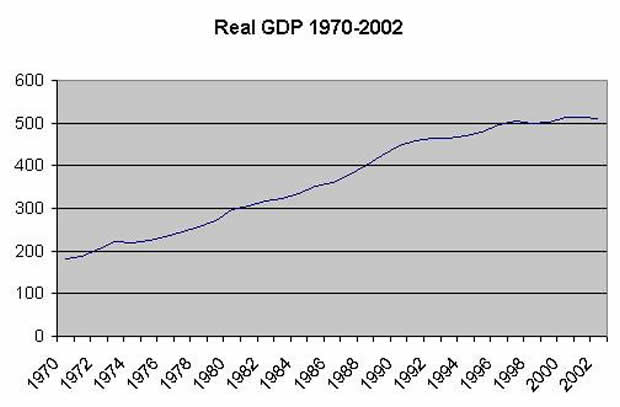
Here, check out a long-term graph of Japan's GDP, in levels:


Looks a bit different, eh? If you looked at this graph in 1996, you would expect Japan to return fairly rapidly to the exponential growth "trend" it had enjoyed up until 1995. Instead, Japan's GDP has remained flat in since then (this is also true in real terms). Here's a picture of Japan's real GDP growth rate over time:


Japan's growth history looks very different from ours. It seems to have suffered some "trend breaks" in growth. And my question is: Why should we believe that this will not happen to us?

One common answer is that long-term growth for a mature economy will continue at roughly the rate of technological progress. But this is a tautology, since economists measure "technological progress" simply as the the long-term rate of GDP growth. This leads some economists to look at slowing growth and conclude that technological progress is slowing. And maybe they're right! The point is that whether long-term growth represents "technology" or some combination of underlying processes, there is no law of the universe that says that these processes grow at a constant exponential rate.

And in addition to "trend breaks," there is no guarantee that U.S. GDP does not also contain unit roots. In other words, the assumption that the dip in U.S. output that we call the "Great Recession" will be made up for by fast growth in the future is unfounded. Even if the U.S. returns to its "trend" growth rate of 2 or 3 percent, there seems to me to be no good reason to believe that it will return to its trend level.

So no, this graph does not ease my worries. Past performance is no guarantee of future results. It may well be that a return to our "trend" growth rate, and/or a return to our "trend" level of output, may be contingent on our policy choices. At least, I am not willing to assume that that is not the case...


Update: I don't want to mislead with the Japan graphs. In per capita terms, the growth slowdown since the mid-90s is much less pronounced. And before the 70s, Japan was well below the richest industrialized nations in per capita GDP, so its mid-70s slowdown is to be expected. But my point about Japan was that the U.S. long-term GDP plot, which is so often used to predict a return to 2-3% growth, is not particularly universal.

Update 2: What "policy choices," you may ask? Well, the answer is that I don't know. My instinct says that clinging to an increasingly broken health care system can't be good for long-term growth. The first-ever U.S. debt default, which Republicans look ever more eager to flirt with, might end our special place in the global economy. Accepting a permanently lower level of taxation and spending might starve the nation of infrastructure and R&D, thus reducing our trend growth. Just some thoughts.

Update 3: I see that G.I. over at The Economist has said much the same thing. And wow...the drops in output in Sweden and South Korea following those countries' financial crises sure look like unit-root drops to the naked eye! 

Update 4: Mark Thoma writes a very long and good post about the "return to trend" controversy, which also cites other long and good posts by Brad DeLong, Greg Mankiw, and Paul Krugman. Definitely read it! And, of course, it almost goes without saying that I think we should try our best to boost output back to the "trend," whether or not that would happen on its own.

Update 5: Brad DeLong has a graph of UK GDP that also shows that "returns to trend" are not universal.
reade more... Résuméabuiyad

Conley and Dupor, revised

A couple posts back, on May 14 I criticized Timothy Conley and Bill Dupor for overstating their results in the abstract of a recent paper on the effect of the ARRA stimulus. The old abstract read:
Our benchmark results suggest that the ARRA created/saved approximately 450 thousand state and local government jobs and destroyed/forestalled roughly one million private sector jobs. State and local government jobs were saved because ARRA funds were largely used to offset state revenue shortfalls and Medicaid increases rather than boost private sector employment. The majority of destroyed/forestalled jobs were in growth industries including health, education, professional and business services.

On May 17, the authors posted a revision. The new abstract reads:
Our benchmark point estimates suggest the Act created/saved 450 thousand government-sector jobs and destroyed/forestalled one million private sector jobs. The large majority of destroyed/forestalled jobs are in a subset of the private service sector comprised of health, (private) education, professional and business services, which we term HELP services. There is appreciable estimation uncertainty associated with these point estimates. Specifically, a 90% confidence interval for government jobs gained is between approximately zero and 900 thousand and the counterpart for private HELP services jobs lost is 160 to 1378 thousand. In the goods-producing sector and the services not in our HELP subset, our point estimate jobs effects are, respectively, negligible and negative, and not statistically different from zero. However, our estimates are precise enough to state that we found no evidence of large positive private-sector job effects. Searching across alternative model specifications, the best-case scenario for an effectual ARRA has the Act creating/saving a (point estimate) net 659 thousand jobs, mainly in government. It appears that state and local government jobs were saved because ARRA funds were largely used to offset state revenue shortfalls and Medicaid increases (Fig. A) rather than directly boost private sector employment (e.g. Fig. B).
The new abstract is completely accurate, and does not overstate the paper's findings. I commend the authors for making the revision.

I would like to think that this represents a case of the blogosphere acting as a useful adjunct to the academic literature (and not just a case of me being a Statistics Nazi). The authors hopefully would have made a similar revision without any blog attention, but you never know.
reade more... Résuméabuiyad

What would it take for an American manufacturing revival?


Note: Posting is sporadic, and will continue to be so, due to the freak occurrence of a natural disaster known as "dissertation"...

Paul Krugman on the maybe-kinda-sorta revival of American manufacturing:
Manufacturing is one of the bright spots of a generally disappointing recovery, and ... a sustained comeback may be under way...[W]hat’s driving the turnaround in our manufacturing trade? The main answer is that the U.S. dollar has fallen against other currencies, helping give U.S.-based manufacturing a cost advantage. A weaker dollar, it turns out, was just what U.S. industry needed.
Why might manufacturing be important? There are many theories, but I tend to focus on the fact that manufactured goods are easily exportable. When goods are easily exportable, relatively small changes in exchange rates can allow large changes in the trade balance, which can be an effective way of fighting recessions. Sure, we export a lot of services, but a change in net services exports big enough to fight a recession probably requires a much bigger movement in exchange rates. And exchange rate are "sticky," they don't like to move a lot. So what we could really use right now is a manufacturing export-driven recovery, enabled by a weaker dollar. Brad DeLong and Christina Romer agree.

As Krugman points out in his column, this will be politically difficult. Why? Krugman blames right-wing ideologues, but I somehow doubt that "strong dollar" money-illusion is high on the list of conservative priorities (maybe I'm wrong). My guess is that the financial lobby opposes a weaker dollar. Right now, the dollar is being propped up by the government intervention of our biggest trade partner, China, which buys U.S. bonds in order to finance its currency peg. Those bond purchases keep U.S. interests rates low, which means that our still-fragile financial system, with its still-huge accumulations of possibly-toxic mortgage-backed debt, gets to pretend for another day that it is still solvent. Low interest rates also allow many finance companies to make large profits through the use of leverage. For the dollar to weaken would require China to stop giving our finance companies free money, and so they naturally oppose a weaker dollar. That's just my guess, anyway.

But there are other, deeper reasons for America to be concerned about its manufacturing sector. These reasons are related to the very first econ theory I ever studied (and still one of my favorites) - the New Economic Geography theory, developed by Paul Krugman himself, for which he won the Nobel back in '08.

This theory is based on a fairly simple concept. Since it costs money to transport goods from one place to another, it makes sense for companies to put their factories near to their consumers. Since workers are also consumers, it therefore makes sense for companies and industries to cluster together. This, basically, is why we have cities. Krugman's model divides the world into an urban industrial "core" and a poorer, sparsely populated "periphery" that produces stuff from the land (e.g. food and oil). The core is much richer than the periphery, so if you are a country, you want to be the core.

In this framework, shifting geographic patterns of wealth can cause booms and busts in far-away places. For example, as the center of global economic activity shifts from Europe to Asia, it may make less sense to locate a bunch of heavy industry in, say, Michigan (which is ideally positioned to supply things to America's Europe-facing East Coast).

The thing is, on a global level the U.S. itself doesn't make a natural "core." We have a lot of land, and not a lot of people on that land; geographically, we look a lot more like your average resource-producing country (say, Argentina) than your average manufacturing powerhouse (say, Brazil). Yes, the U.S. has some pockets of high density, and yes, the existence of tradable services complicates the picture. But if you read the news, you hear all the time about companies relocating production to Asia to (hopefully) take advantage of the huge new Asian consumer markets. That is economic geography in action.

If we want to bolster our manufacturing sector over the long run - whether to give us a better way to fight recessions, or to allow us to continue to benefit from industrial clustering, we may need to increase our population density over time. This will require that we do two things. First, we have to continue to allow large-scale immigration. Second, we have to make big policy changes to encourage urban density - public transit, high density housing, etc. Basically, the kind of stuff that Ed Glaeser is always recommending that we do. The alternative (and here I exaggerate) may be a steady process of deindustrialization as we revert to being an exporter of corn and coal.
reade more... Résuméabuiyad

Who is blocking high-skilled immigration?

One native-born American, one (very) high-skilled immigrant.


There is a puzzle in the American political economy that has me utterly baffled. Readers and fellow bloggers, I need your help to solve this puzzle. The question is: Who is the constituency holding back high-skilled immigration to the United States?

Few economists would argue that high-skilled immigration is not an undiluted positive for the American economy. In fact, it is one of the only sources of "low-hanging fruit" (as Tyler Cowen would put it) that we have left. Here's Annie Lowrey:
But maybe there remains one last shiny, fat apple hanging right in front of our faces, one last endeavor that would bring us fast, costless, and easy growth. It is immigration reform. The United States can grow faster by stealing the rest of the world's smart people.

[F]oreign-born entrepreneurs were at the helm of a full quarter of Silicon Valley start-ups founded between 1980 and 1998—start-ups like, say, Google. In 1998 alone, those companies created $17 billion in sales and accounted for 58,000 jobs.

Since then, the contributions of highly skilled immigrants—let's call them super-immigrants—have only grown...25.3 percent of engineering and technology start-ups opened between 1995 and 2005 had a foreign-born founder...Immigrant-founded companies across the country produced $52 billion in sales and employed 450,000 workers...[I]mmigrants are 30 percent more likely to start a business than U.S.-born citizens. Immigrants with college degrees are three times as likely to file patents as the domestically born...Economist Jennifer Hunt of McGill estimates that the contributions of immigrants with college degrees increased the U.S.'s GDP per capita by between 1.4 and 2.4 percent in the 1990s. 
For some reason, though, there exists a vast thicket of U.S. policies and practices that keep high-skilled immigrants out. H1-B visas are temporary, severely limited in number, and annoyingly hard to get. Our student visa program kicks foreign students out right after they finish. The number of "employment-based" green cards is capped at 140,000 a year, which heavily tilts our immigration policy toward family reunification and away from high-skilled immigration.

It goes without saying that this is nuts. By keeping these people out, our nation is shooting itself in the foot with a sawed-off shotgun.

But this raises a huge, looming question: Who or what is behind this insanity? Usually, when economists  see such a gross and persistent miscarriage of policy, we look for a vested constituency that has successfully used the political process to block national efficiency in order to favor its own narrow interest. But, for the life of me, I can't figure out who is against high-skilled immigration.

It doesn't appear to be the political far right. Tea Partiers and the like are up in arms about immigration, but all of their animus is directed at low-skilled immigrants, particularly Mexicans. They are not marching in the streets or joining Minuteman squads because of Indian computer programmers.

Nor is it business conservatives. Check out this Wall Street Journal article by Jonah Lehrer, which basically echoes Lowrey (yes, I view the WSJ as a barometer of business-conservative opinion). Or read AEI calling for reform of our high-skilled immigration policy. After all, high-skilled immigrants are a huge boon to American business, which is why tech companies are always lobbying Congress (unsuccessfully) to increase the number of H1-B visas.

It isn't libertarians. Libertarians favor (relatively) open borders.

It doesn't seem to be the political left. Observe this article by David Altman in the Huffington Post, which used the term "super-immigrants" months before the Lowrey article, and basically says the same things (yes, I view the Huffington Post as a barometer of elite-liberal opinion). Liberals, after all, tend to favor a multicultural society. They also favor income equality, which high-skilled immigration tends to promote. Maybe Democrats are afraid that the children of entrepreneurial immigrants will vote Republican, but in recent years Asian-Americans have trended Democratic.

Is it the security state? Yes, the influx of foreign students and workers dropped off after 9/11, but has since recovered. It seems conceivable that the DHS and other arms of the security apparatus are paranoid about smart terrorists or Chinese spies. But I have not heard of the DHS lobbying to keep out high-skilled immigrants. Is this happening?

What about high-skilled native-born Americans? Are American-born computer programmers, engineers, and entrepreneurs afraid that high-skilled immigrants will take their jobs? I guess this is conceivable. I've heard some low-level grumbling from American-born engineers about the low wages and long hours that immigrant engineers are willing to accept, but I know of nothing even slightly resembling an organized movement or lobbying effort. And my guess is that smart Americans are smart enough to know that it's a positive-sum game - that the positive impact of the businesses started by smart immigrants vastly outweighs the effects of wage competition.

So who is it? Is there someone I'm forgetting here? Have I made a mistake in my analysis? Or is my instinct wrong - is it simple blind dumb institutional momentum, and not the diabolical actions of any special interest group, that is keeping world's geniuses shivering outside our tall iron gates? Is it simply that no one is paying attention? Help me out here, people. Help me understand why we have not yet picked this lowest of low-hanging fruit.


Update: E.G. at The Economist has an excellent post comparing Canada's attitude toward high-skilled immigrants to America's. All of the commenters who wrote that "we have enough smart people already" should read it.
reade more... Résuméabuiyad

Did the stimulus really destroy a million private-sector jobs?


Hey non-economists, want to see what's inside the guts of one of those econ papers you keep hearing about? Well that's why you have grad student bloggers like me. We read the papers so you don't have to.

This week, Greg Mankiw links us to a paper by Timothy Conley of Western Ontario and Bill Dupor of Ohio State University. The paper's eye-popping finding is that the American Recovery and Reinvestment Act (ARRA), also known as the Stimulus, was responsible for a net loss in jobs. No, really! From the paper's abstract:
Our benchmark results suggest that the ARRA created/saved approximately 450 thousand state and local government jobs and destroyed/forestalled roughly one million private sector jobs...The majority of destroyed/forestalled jobs were in growth industries including health, education, professional and business services.
Wow! Seriously? The stimulus directly resulted in a net loss of five hundred and fifty thousand jobs? That's it, I'm voting Republican from now on...

But wait. A still small voice is nagging me from the back of my mind, urging me to read beyond the abstract. And so my dissertation will have to wait 40 minutes while I wade through three dozen pages of PDF in search of an answer to my nagging doubts.

Because I do have some doubts about this result. Stimulus spending destroys jobs? How the heck is that supposed to work? I mean, maybe you believe in full Ricardian Equivalence, but that would just predict that stimulus is a wash. Perhaps people are cutting back spending in anticipation of the deadweight losses caused by the future taxes needed to pay back the stimulus-related borrowing*? Hmm, maybe, but that sounds so preposterous that I kind of expected something to be fishy about this paper from the get-go.

What Conley and Dupor do is to run a state-by-state regression. Different states received different amounts of ARRA spending, so looking at the differences in employment growth rate between those states after the passage of ARRA should tell us how many jobs ARRA created or destroyed. This should lead to a regression of the type:
Employment growth = A + B*Stimulus + C*Other Stuff + e
Now, you may say: "Wait, but states where employment goes down should be expected to get more stimulus money, since those are just the states that were hardest-hit by the recession!" And you'd be right: there is a big endogeneity problem here. After all, the fact that there's a bunch of sick people in the doctor's office doesn't mean that doctors make you sick. Messrs. Conley & Dupor deal with this problem by finding some "instruments" - natural sources of variation in the amount of stimulus money that a state gets, that have nothing to do with how bad the state's economy was doing. Usually, critics of an empirical paper like this will try to say that the instruments used are bad ones - that they actually can be affected by the business cycle, or that they don't give rise to enough variation in stimulus funding. 

I am not going to do that. I am going to give Conley & Dupor a free pass on their instrumental variables, because I already see one and possibly two gaping hole in their analysis that makes the instrument problem somewhat of a sideshow.

(Update: I had initially written about a second possible problem with this paper, but commenter Ivan found evidence that (thankfully) that problem didn't exist. So, in the interests of not making people read several pointless paragraphs, I've deleted the section that was previously here. Thanks, Ivan!!)

On page 20 of their paper (Table 4), Conley and Dupor have a table that shows their main result: the number of jobs that they estimate to have been created or destroyed by the stimulus. In all private sectors, the estimates are negative. BUT, check out the confidence intervals in Table 4. With one exception, the upper limits of all the confidence intervals are highly positive. This despite the fact that they use a less-rigorous 90% confidence interval (instead of the standard 95%).

This means that Conley and Dupor's results are statistically insignificant. Bluntly, what they have found is nothing. Formally, if we use their model to test the hypothesis that the stimulus caused a net increase in private-sector jobs, we will not be able to reject the hypothesis.

Conley and Dupor tweak their model with some alternative specifications. No change. As you can see in Table 7 and Table 9 (p.23-4), upper 90% confidence limits continue to be strongly positive. If the authors really did leave the intercept term in their regression equation, then that's probably why they got insignificant results; if not, then there's some other problem with their instruments or their specification, or maybe just the data itself.

But, given the lack of any statistically significant findings, this paper does not deliver the results that it advertised. Conley and Dupor's abstract should read "We find no evidence for a significant effect of the ARRA on job creation." That would be scientifically honest, but would not turn a lot of heads. Instead, the abstract makes the more politically incendiary claim that the ARRA destroyed jobs, which the authors actually did not find. They do leave themselves an escape rout by using the word "suggest," but I am not satisfied. In my opinion this is a paper that overstates its findings. (Note: Conley and Dupor have since revised their abstract significantly to more accurately reflect their results, for which I commend them!)

My guess is that papers like this get attention because of politics, not because of science. Dr. Mankiw linked to this paper without comment, evaluation, or qualification. But he could have just as easily linked to this paper by Daniel J. Wilson, which uses a methodology similar to that of Conley and Dupor, but finds strongly positive (and often strongly significant) effects of the stimulus.


Update: Arnold Kling is also not a fan of Conley-Dupor. 


* Actually, it's worse than that. You have to also assume that future deadweight losses from stimulus-payback taxation will be highly concentrated in the states that received the most stimulus funding; i.e., that taxes will be specifically targeted at those states! 
reade more... Résuméabuiyad